The documenting of wars is a contentious subject. The hawks don't want to keep the war secretive and distant while the doves want it all on the line, open for all. What is an acceptable standard for war photography? How graphic is too graphic for the front page? Ultimately it becomes a question of how comfortable (or knowledgeable, even) we are of the wars that our country involves itself in. People always talk about how integral the media was to our memories and knowledge of the Vietnam War. Some say it was a detriment to the effectiveness of our military, and some say the coverage was necessary as a system of democratic oversight. At what point, though, does journalism become sensationalism? I am reminded of a specific image that appeared on the front page of the New York Times several years ago. It showed four dead American soldiers hanging from a bridge in Iraq. Their bodies had been burned beyond recognition. They had also been mutilated and deformed. I would not have recognized them as American soldiers without the caption telling me so. The picture itself is only there to provoke an emotional response. The caption then directs that emotion into an opinion. I disapprove of the war, and I believe in freedom of the press in all situations. But, I do not believe in using journalism as an ideological weapon.
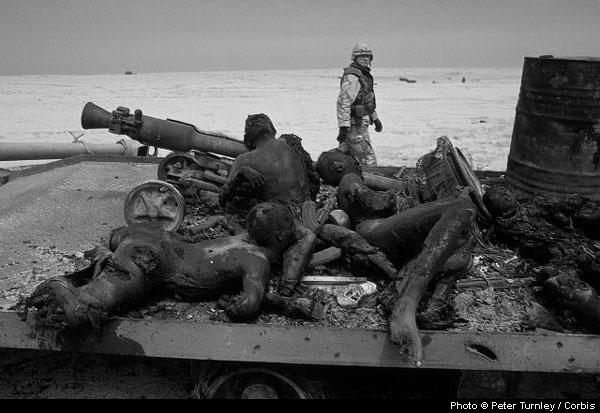
In the case of Peter Turnley's photographs, it's a little more complicated. It's true that the Gulf War carries a much softer visual imprint on our minds than Vietnam does. That, in part, is due to some heavy government censorship. Where Vietnam has a few iconic images that almost every American can summon at a moment's notice, the Gulf War has none. I can't think of a single one. The only thing that comes close, for me, is a news clip shown on CNN of anti-circraft fire rising dramatically above Baghdad on the eve of the war. His photographs all take place after the war occured. There is something very quiet and peaceful about his photography. None of the American soldiers are running. There are no guns being fired. There is only death and sand on view here. It presents a very specific view of the Gulf War, simply because of the fact that he was not around to document any of the actual fighting. The pictures are compelling and beautiful, but I feel like I'm not being shown the whole story. It is impossible to create a truly objective photograph (the unreachable ideal for photojournalists, supposedly), and I think that the only way to get a comprehensive idea (not knowledge) of what's going on is to get information from as many sources as you can and from as many points of view as you can.

No comments:
Post a Comment