If I got one good thing out of this project, it was a skill set. After 20+ hours in front of a computer screen masking tiny chunks of sky from in between the girders of a crane (among other things), I now feel fairly confident in my photoshopping skills. I'm not saying I could do anything and everything with the program. I'm just saying that I've reached a level of confidence I'm pretty happy with.
As for the panorama itself, I guess I could take it or leave it. I think the photoshop perfectionism got to me toward the end, and what resulted was a formulaic composition that might have been found in a 17th century northern Renaissance alterpiece. The planes were overkill---a last minute addition at an obscenely late hour. I knew, even as I masked their vapor trails and oulined their pointy wings, that it was a mistake, and yet somehow I rode the perfectionist momentum towards mediocrity. I guess you could say I got another valuable lesson from this project: don't let photoshop second-guess your work for you! When you work in such detail, it's very easy to lose track of the work as a whole. Frankly, I was pretty disappointed with the tiny amount of ground that my photoshopping resulted in. Perhaps a dozen square inches out of a panorama that was 40 inches long. I have to admit: it looks pretty slick, but if I had to redo the assignment I would definitely go in a different direction.
11.23.2008

11.19.2008
Baby Pictures
Baby pictures as "scientific evidence" (read: propaganda) to further the agenda of white supremacists---who knew? It really does sound ridiculous, but the chapter Elizabeth had us read for tomorrow's class seems to make a pretty good argument for their use as such. There were a few examples in that article that were unequivocally eugenicized, such as the homogenized family albums (with specific instructions on how to record the physical and mental development of your child from birth to age 18---at which point the eugenicists could then supposedly use the album to support their scientific hypotheses). However, the article didn't define what makes a racist album and what makes a normal one. Is the entire notion of a photo album racist? According to the article, that idea seems to be due to the popularization of albums in post-war magazines geared toward middle-class white women. Without that information though, what inherent properties of a photo-album support that argument? I was confused, or at least left with a few questions. It's true that albums carry with them a certain air of importance. Simply by dint of their physical nature, they are reserved for special occasions. Nobody flips through their own family album on a daily basis. The second article, by bell hooks, made a specific distinction between albums and framed photographs (which can be displayed at all times throughout the house). That article also made a case for childhood documentation as a preserver of familial history in the face of racial oppression. These two articles are dealing with the same topic (albeit in a different circumstance) and they take completely contradictory viewpoints.
Most of my baby pictures are safely tucked away in albums, far from public view. However, a few have made the transition to frame life. They sit on shelves or desks or what have you, but they don't get much more notice than the albums do. I think it ultimately boils down to the nature of your family, and how important images are to that group. Personally, I haven't had a picture taken of me in years (probably not since prom), and I occasionally lament the loss of these years toward posterity. Then I remember that my place in this world is next to nothing, and it doesn't seem so important any more. Concerning these two articles, I would ask: "No matter what the conceived point, how does this collection of photographs matter outside of this familial bond?" The answer, in almost every case, is that it matters not.
Most of my baby pictures are safely tucked away in albums, far from public view. However, a few have made the transition to frame life. They sit on shelves or desks or what have you, but they don't get much more notice than the albums do. I think it ultimately boils down to the nature of your family, and how important images are to that group. Personally, I haven't had a picture taken of me in years (probably not since prom), and I occasionally lament the loss of these years toward posterity. Then I remember that my place in this world is next to nothing, and it doesn't seem so important any more. Concerning these two articles, I would ask: "No matter what the conceived point, how does this collection of photographs matter outside of this familial bond?" The answer, in almost every case, is that it matters not.

11.15.2008


11.12.2008


Leni Riefenstahl
In response to the following:
http://arts.guardian.co.uk/pictures/0,,1267862,00.html
For me, Leni Riefenstahl has always been a very difficult persona to come to terms with, both artistically and historically. Her work has value in that it contains creativity, but it is her intentions that give me so much trouble. In high school, I wrote a research paper on the topic of National Socialist art and propaganda in Germany in the 1930s, and I have to admit that Leni Riefenstahl's films and photographs are probably the most creatively rich bodies of work to come out of that country in that decade. Most of everything else was either propaganda or trite amalgamations of earler art movements whose values were in line with the Party-endorsed cult of the volk. That does not mean Riefenstahl's work was completely unfettered. I have seen "Triumph of the Will," her 1935 documentary of a Nazi Party rally in Nuremberg, and it definitely treads the line between art and propaganda. At that point, it's all a matter of intention, and I cannot trust her post-war claims of ignorance. From the New Yorker article, she seems to have been something of an opportunist, if not exactly a sympathizer. Her personal relationship with the Hitler could not have been a bigger boon to her career. The production values of "Triumph of the Will" are incredibly high. For a documentary made in 1935, it exhibits a veritable wealth of camera angles and shots. Riefenstahl must have had a small army of camera operators and assistants to create such a grandiose work. No doubt Hitler planned to use her film as propaganda, but I still wonder as to Riefenstahl's own intentions.
11.10.2008
Annie Leibovitz
In response to: http://missgeeky.com/2008/01/29/annie-leibovitzs-disney-dream-portrait-series/
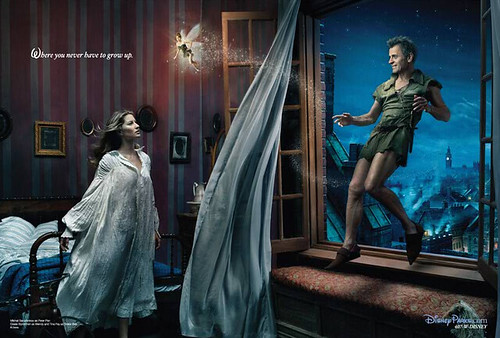
When I first glanced over the Disney ads, I said to myself, "Ok, another slick photoshop montage. Annie Leibovitz has finally caved." Then I took another look, and began to change my mind. Sure, the Disney shots are pure photoshop creations, but that's never really been the thing that bothers me about severely altered images. What bugs me is that people seem to think its ok to publish a crappy image, as long as it's been irradiated by the healing brush and the clone stamp. Leibovitz's Disney photographs are arranged so precisely that they could be paintings. I would say that they could even be stills from the films, but they're too precise for even that. They are hyper-real Disney archetypes. They're real enough for us jaded types who haven't felt the magic in years to actually get into it a little. Disney movies are familiar---so are celebrities. I won't go so far as to say that the photographs are clever per se, but I couldn't help but smile when I saw Beyoncé as Alice, or Baryshnikov as Peter Pan. By tossing two incredibly recognizable images together (the costume and the celebrity face inhabiting it), Leibovitz forces us to make a choice: is this really Prince Charming? Or is it actually David Beckham? Some would say it could be both. Some would have a hard time reconciling the two. Aside from being visually stunning, the photographs actually introduce an interesting dialogue between the notions of recognizability and celebrity. The two may be similar, but they (and their respective components of Leibovitz's pictures) are just different enough to introduce some tension into the mix.
When I first glanced over the Disney ads, I said to myself, "Ok, another slick photoshop montage. Annie Leibovitz has finally caved." Then I took another look, and began to change my mind. Sure, the Disney shots are pure photoshop creations, but that's never really been the thing that bothers me about severely altered images. What bugs me is that people seem to think its ok to publish a crappy image, as long as it's been irradiated by the healing brush and the clone stamp. Leibovitz's Disney photographs are arranged so precisely that they could be paintings. I would say that they could even be stills from the films, but they're too precise for even that. They are hyper-real Disney archetypes. They're real enough for us jaded types who haven't felt the magic in years to actually get into it a little. Disney movies are familiar---so are celebrities. I won't go so far as to say that the photographs are clever per se, but I couldn't help but smile when I saw Beyoncé as Alice, or Baryshnikov as Peter Pan. By tossing two incredibly recognizable images together (the costume and the celebrity face inhabiting it), Leibovitz forces us to make a choice: is this really Prince Charming? Or is it actually David Beckham? Some would say it could be both. Some would have a hard time reconciling the two. Aside from being visually stunning, the photographs actually introduce an interesting dialogue between the notions of recognizability and celebrity. The two may be similar, but they (and their respective components of Leibovitz's pictures) are just different enough to introduce some tension into the mix.
11.06.2008


Self-Assessment
Animation Project:
When I first started out with this project, I was a little worried about how I could possibly collect enough material for a 3-minute movie. Fortunately, I overcame this slight fear to end up shooting over 2,800 images my first day, and about 2,000 the next. The sheer volume of shooting was a great exercise, it was the editing and re-shooting that really shaped this project. It's one thing to go out to a site and just collect and collect, not really thinking about any specific direction or narrative. It's a completely different thing to then turn all that raw material into something worth looking at. A single good photograph can stand alone. A good movie still, or even a great movie clip, rarely if ever stands on its own as a work of art. Pop-culture icon, maybe, but not art. Movies are immensely long strings of images, and it's the editing that makes the movie. The editing was tough (especially with iMovie), but it was incredibly satisfying to see the narrative slowly gel over time.
Free Shoot:
I absolutely love these images. I hope I'm not sounding too vain, but I really like the way they look, and I want to make more just like them. It's a great feeling to be able to make something that satisfies you. Obviously it does matter to me what other people think of them, but not as much as it might have a year or two ago. I feel like I'm starting to be able to look past criticism and focus on the kind of themes and aesthetics that fulfill my own desires. I think this is a good sign, but I'm not sure yet. I don't want to end up being ambivalent about criticism. All I know is that I like where I am, and I have a vague direction to head off into. That's all I really need, I feel that whatever I end up being proud of will guide me.
When I first started out with this project, I was a little worried about how I could possibly collect enough material for a 3-minute movie. Fortunately, I overcame this slight fear to end up shooting over 2,800 images my first day, and about 2,000 the next. The sheer volume of shooting was a great exercise, it was the editing and re-shooting that really shaped this project. It's one thing to go out to a site and just collect and collect, not really thinking about any specific direction or narrative. It's a completely different thing to then turn all that raw material into something worth looking at. A single good photograph can stand alone. A good movie still, or even a great movie clip, rarely if ever stands on its own as a work of art. Pop-culture icon, maybe, but not art. Movies are immensely long strings of images, and it's the editing that makes the movie. The editing was tough (especially with iMovie), but it was incredibly satisfying to see the narrative slowly gel over time.
Free Shoot:
I absolutely love these images. I hope I'm not sounding too vain, but I really like the way they look, and I want to make more just like them. It's a great feeling to be able to make something that satisfies you. Obviously it does matter to me what other people think of them, but not as much as it might have a year or two ago. I feel like I'm starting to be able to look past criticism and focus on the kind of themes and aesthetics that fulfill my own desires. I think this is a good sign, but I'm not sure yet. I don't want to end up being ambivalent about criticism. All I know is that I like where I am, and I have a vague direction to head off into. That's all I really need, I feel that whatever I end up being proud of will guide me.
11.02.2008
Subscribe to:
Posts (Atom)